
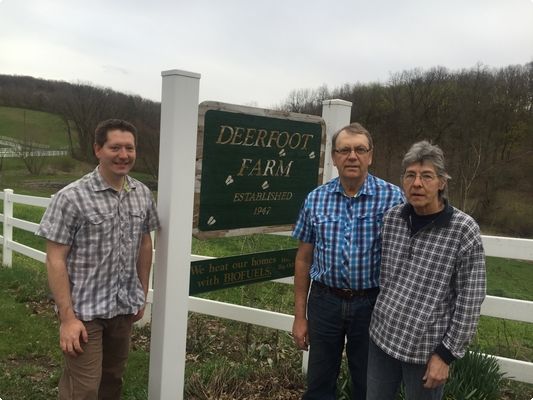
They say the 94 acres of hills and valleys that make up Deerfoot Farm are not ideal for farming. But that land has been good to the Brown family, supporting feed for a modest dairy operation on which David was raised. He maintained it until the 1990s. The land, tucked on the northern side of Lake Ontelaunee in Maidencreek Township, gave David and Christine Brown fields of canola for biofuels when gas prices were high. It gave them a bounty of sweet corn and cantaloupes that they sold at the Leesport Farmers Market and virtually paid for his son, Dan, to attend Penn State.
Shall we dance?
David wasn't looking for a spouse when he signed up for ballroom dance lessons in Hamburg more than 40 years ago. Neither was Christine. They were 22. She was the daughter of a German immigrant; he was the son of a city-to-farm transplant, but they fell in love.
Together they've farmed, worked and raised a family. They have two children: Dan, 36, and Nancy Tracht, 34. Nancy has two daughters, Natalie and Caitlyn.
Of cows and umbrellas
When David and Christine tell the story of their first weeks on the farm, their sentences overlap, each adding detail as they reach the punch line.
Before they were married, “I would visit on weekends,” Christine said.
“We would show her the nice quiet cow to learn to milk,” David said.
The story continues like this: Shortly after they were married, David and Christine took charge of the farm one weekend while his parents went on a long-deserved vacation.
One particularly rainy afternoon, Christine, who was not a farm girl, tried to bring the cows across the street into the barn for milking, a job that requires two people. David was in the field with the cows. The cows wouldn't budge. Instead, they ran in circles but wouldn't cross the street.
“Your umbrella,” David hollered across the road. “Close it.”
Christine didn't want to get her hair wet, but she closed the umbrella. And the cows moved.
“I was heartbroken,” she said.
The story doesn't end there. When they tried to move the cows back to the field, Christine figured out that opening the umbrella got the cows to move. That is how Christine began to understand just how dumb cows are, and how to think like a dairy farmer.
“You have to be smarter than they are dumb,” David said.
It was a lot to learn. There would be difficulties in farm life but they had them together, Christine said.
“I knew what his day was like because it was my day, too,” she said.
Unconventional
Because his father was new to farming, David says they have never felt bound to traditions or conventional ways of doing things.
His father learned by reading and followed the scientific writings of Penn State professors. This attitude has kept David open to new ideas. For instance, even though it saddened him, he gave up the dairy operation when he couldn't see a way to support his family with it.
He's grown canola and used biofuels to heat his home. For a time he handmade patterns for plastic molds at Tray-Pak Corp., while Christine supplemented their income as a surgical tech and a licensed practical nurse. She retired from Penn State Health St. Joseph last year.
The farm is preserved through an $230,000 easement purchased by the county in 2009.
The farmer and the sky
David is president of the Berks County Astronomical Society. Since his first gaze through a telescope his father bought from Sears at age 9 he's been fascinated by the cosmos.
“When you see the beauty of the universe you realize it can't be happenstance,” he said with an awe and fervor typically reserved for religious experiences.
He has a telescope so large he uses a trailer to haul it to schools and other locations to study the sky.
He loves sharing that experience, watching a 7- or 8-year-old look into the eyepiece and seeing a light bulb come on.
“I thoroughly enjoy turning them on to science,” David said.
He has seen some interesting astronomical events such as the Shoemaker-Levy 9 comet crashing into Jupiter. This summer he will travel to Tennessee to see his first total solar eclipse.
Duly noted
In addition to astronomy, David plays saxophone, just like his father, Carl N. Brown. Carl played the sax with bands in nightclubs around Reading during the Depression. That's how he met David's mother, Mary Hafer, a singer for an all-girls group. She had grown up on a produce farm in Oley.
The music continues, as Dan also plays saxophone. Christine, on the other hand, said she doesn't play or sing.
“I couldn't carry a tune in a bucket,” she said.
Making hay and wine
The Browns still make about 18,000 hay bales, maybe 20,000 this year, with the help of a few teenagers working part time. They also grow grapes — 300 pounds last year — and make wine. The winery produced 1,500 gallons last year, all of it corked by hand.
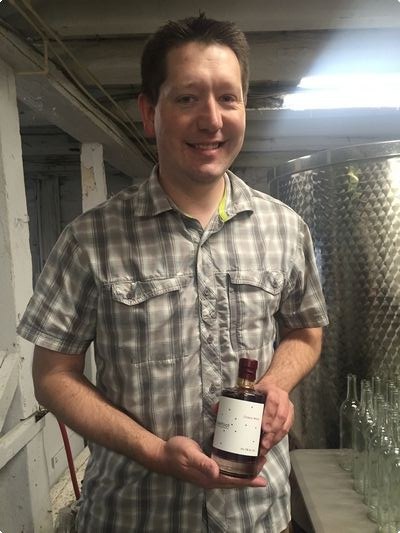
Dan's been making wine in the former dairy barn for about a decade. He plans to open a small tasting room in the old smokehouse.
He believes a winery set on a working farm will make it more attractive to visitors.
Turns out that mediocre soil and the south-facing hillsides are perfect for grapes.
They also produce mead, which is made from honey. Those bottles bear labels designed by Dan's wife, Jaime, an art teacher in Lancaster County.
Dan is a software designer in Harrisburg. They are renovating the 1830 farmhouse to move home and eventually take over the farm.
David made all the cabinets in the kitchen, even though he has no formal carpentry training.
In Faces in the Fields, reporter Lisa Scheid introduces the interesting personalities in local agriculture. If you'd like to suggest someone to feature, contact her at 610-371-5049 or lscheid@readingeagle.com.